How stormwater drains work
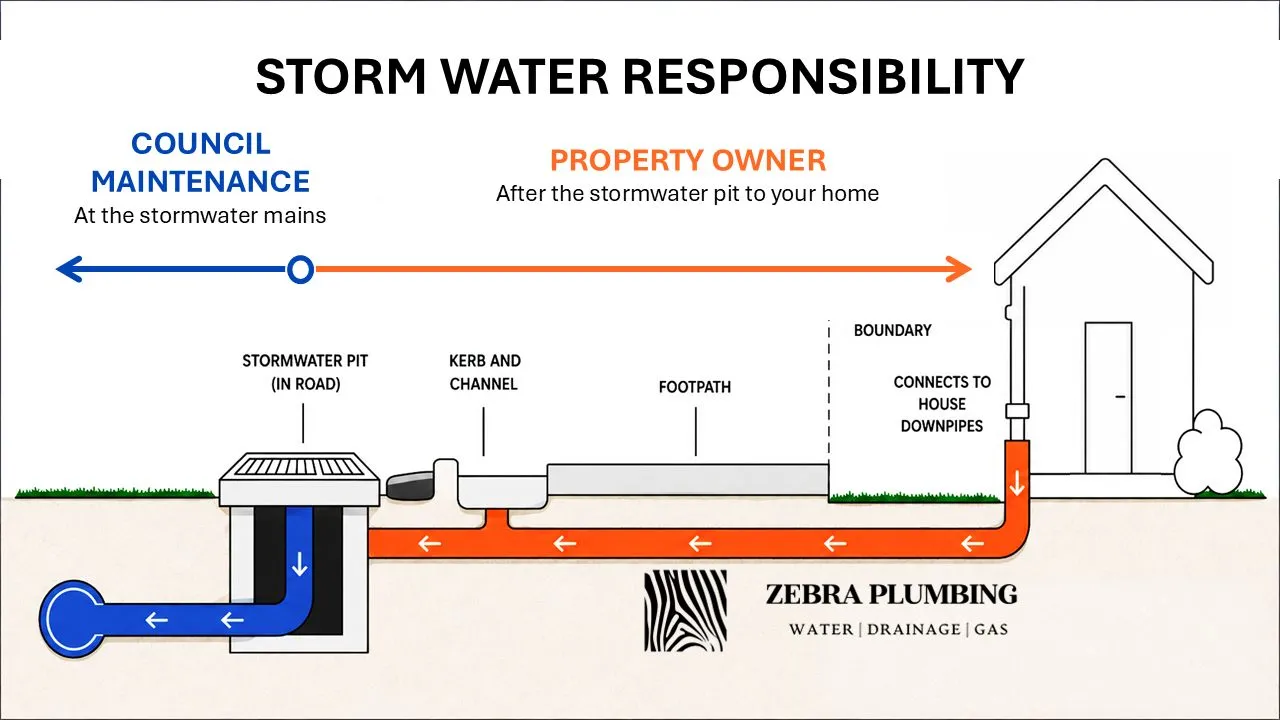
Rain runs off your roof into the gutters, down the downpipes and into an underground stormwater line, sometimes through pits in the paving or garden. That line runs to the kerb or a council drain. Because it takes leaves, silt and whatever washes off the roof, it blocks for different reasons than your sewer.
What it usually means — most likely first
- Leaves and silt in the line. Gutter debris washes into the downpipe and settles in the underground pipe, especially at bends and flat sections. A downpipe that fills to the top in rain usually means a blockage below it. On a recent Richmond job, one downpipe was completely full of water while the others ran clear — the blockage was in the stormwater line beneath it.
- Tree roots. Stormwater lines are often older clay or thin-walled pipe close to the surface, and roots get in at the joints.
- A broken or crushed pipe. Driveways, landscaping and building work can crack or crush shallow stormwater pipe. We see lines broken by concrete and excavation work.
- A blocked pit or kerb outlet. A silted-up pit in your yard, or the outlet at the kerb, can back the whole line up.
- Blocked gutters or rainheads. Sometimes it really is the roof: a gutter full of leaves spills before water ever reaches the downpipe.
What you can safely check yourself
- Watch where it overflows in rain. Gutters spilling along their length point to the gutter. One downpipe backing up to the top points to the line under it.
- Clear the grate on any surface pits in the paving or lawn, and lift out leaves you can reach.
- Check the kerb outlet where your stormwater meets the street, and clear leaves or silt from the opening.
- Clean the gutters only if you can do it safely from a ladder on level ground, with someone holding it. Otherwise leave roof work to someone with the right equipment.
- Keep water away from the house. If it’s pooling against a wall, move what you can and note where it sits. Water against foundations is worth getting onto.
What not to do
- Don’t pull downpipes apart to let them run onto the ground. It just moves the water against the house.
- Don’t connect stormwater to the sewer, or the sewer to stormwater. It’s illegal, and it overloads the sewer in storms.
- Don’t hose sewage into a stormwater pit if a sewer gully overflows. Stormwater isn’t treated before it reaches creeks and the bay.
- Don’t climb onto the roof in wet weather.
When it’s time to call a plumber
- A downpipe fills to the top or overflows at the joint in ordinary rain
- Water pools against the house or under it
- A pit overflows when it isn’t a downpour
- The ground is sinking or wet along the line of a pipe
- It started after building, driveway or landscaping work
Downpipe backing up every time it rains? The blockage is usually in the line underneath. Call 03 4052 7746 — phones are answered 24/7 — or request a call back and our team will ring you, usually within 30 minutes during business hours.
How Zebra finds and fixes it
Find the blockage first. We run the CCTV camera through the stormwater line while you watch the screen, and the pipe locator marks where the blockage or damage sits. Where there’s no access point, we can cut into the affected downpipe to get the equipment in, then reinstate it.
Clear it properly. The hydro jetter flushes silt, leaves and roots out of the line, and the camera goes back in so you can see it running clear.
One fixed price, approved before any work starts. We quote one fixed price for the fix and nothing starts until you approve it. The quote is obligation-free.
The honest bit: if the camera shows the pipe is broken or crushed, clearing it won’t last — the fix is repairing that section, and you’ll see why on screen first. Our workmanship is backed by a lifetime labour warranty. More on our stormwater drains service.
Whose drain is it?
Everything on your side of the connection point is yours to maintain: the pipes under the house and yard, the overflow relief gully, and — in older suburbs — the boundary trap. Your water corporation (Yarra Valley Water, South East Water or Greater Western Water, depending on where you live) owns the sewer main itself, and the council owns the street's stormwater drains. Older and subdivided blocks sometimes share one combined drain across several properties, and a fault in the shared section is usually a shared cost. We camera and locate the fault first, so you know exactly whose side it sits on before anything is quoted — and if it turns out to be on the corporation's side, we'll say so and point you to their faults line rather than charge you for someone else's pipe. One tip worth acting on today: keep your overflow relief gully (the grated drain outside, usually near a side or rear wall) clear and uncovered. It's designed to spill outside instead of through your bathroom floor, and insurers can take a dim view of a blocked or built-over gully after a sewage spill.
Common questions
Is stormwater the council’s responsibility?
Why does my downpipe overflow at the bottom?
Is it OK to let downpipes run onto the garden?
How soon can you come?
More plain-English help in our drain guides.